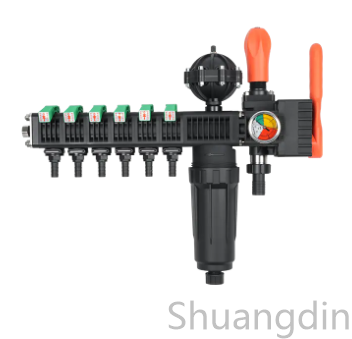
Agricultural spraying systems require dependable fluid delivery to distribute pesticides, herbicides, fertilizers, and other crop treatment solutions across different growing environments. The pump is a central component because it moves liquid from the storage tank into the distribution network and supports the operation of connected nozzles. A Sprayer Diaphragm Pump uses a flexible diaphragm and a valve assembly to create alternating suction and discharge movements. This operating principle provides a practical approach to liquid handling while keeping the pumped fluid separated from the main mechanical drive components.
The pumping process begins when the diaphragm moves away from the chamber, increasing its internal volume and creating suction. Liquid enters through the inlet valve and fills the chamber. When the diaphragm moves back, the chamber volume decreases and the liquid is directed through the outlet valve. Repeated movement produces the flow needed by the spraying system. The inlet and outlet valves help control the direction of liquid movement, while the diaphragm forms the flexible barrier responsible for displacement. The quality and coordination of these components influence the stability and reliability of the pump.
Material compatibility is especially important in agricultural applications. Crop treatment liquids can contain active chemical ingredients, dissolved nutrients, additives, and suspended substances. These formulations may affect elastomers, plastics, and metal surfaces in different ways. The diaphragm must retain its flexibility and sealing ability during repeated operation, while valves and seals need to withstand contact with the intended liquid. If materials are unsuitable, components may swell, harden, crack, or lose their sealing performance. Selecting a pump therefore requires checking the manufacturer's material recommendations against the chemicals and cleaning solutions that will be used.
The pump must also be matched with the complete spraying system. Liquid typically travels from the tank through an inlet filter before entering the pump. It then moves through pressure-control components, hoses, distribution lines, and spray nozzles. Each part affects the performance of the overall arrangement. A restricted filter can reduce liquid supply, while worn valves may affect the pump's ability to maintain consistent delivery. Incorrectly selected nozzles or poorly arranged distribution lines can also create uneven application. Considering the pump and connected components together helps support a balanced system.
Agricultural working environments can be demanding. Spraying machinery may encounter dust, moisture, vibration, temperature changes, and uneven ground. These conditions make housing strength, mounting stability, and connection quality important design considerations. A durable housing helps protect internal components, while secure mounting reduces unnecessary movement during operation. Hoses should be routed away from sharp edges and moving machine parts to minimize abrasion. Connections should remain accessible for inspection, allowing operators to identify loose fittings or signs of leakage before they develop into larger problems.
Maintenance practices have a direct influence on operating reliability. Before each spraying task, operators should inspect the tank connection, inlet filter, hoses, clamps, and visible seals. Filters should be cleaned when residue or particles begin to restrict liquid flow. After application, flushing the system according to the pump manufacturer's instructions and the chemical supplier's safety guidance helps remove remaining liquid. This is important because certain agricultural formulations may leave deposits or residues that interfere with valves and internal passages. Regular inspection of the diaphragm and valve assembly can help identify wear before it affects the spraying process.
The design of the diaphragm also influences the pump's service life. It must flex repeatedly without losing its ability to create an effective seal. Material composition, manufacturing consistency, and assembly accuracy all contribute to this performance. Valve components must also respond reliably to changes in chamber pressure, allowing liquid to move in the correct direction during each cycle. For manufacturers and distributors, consistent production standards and access to compatible replacement parts are important considerations when evaluating a pump supplier.
Selecting suitable spraying equipment requires an understanding of the intended application. Field crops, orchards, greenhouses, and localized treatment operations may involve different liquid formulations and distribution arrangements. Buyers should consider chemical compatibility, operating frequency, equipment layout, maintenance access, and the requirements of the connected spraying components. A pump should not be evaluated by one feature alone; its construction and operating characteristics need to match the demands of the complete machine.
Reliable crop spraying depends on the interaction between pump design, liquid properties, installation quality, and regular equipment care. A properly selected Sprayer Diaphragm Pump can support controlled fluid movement when its materials and operating requirements are compatible with the application. For agricultural machinery manufacturers, distributors, and equipment buyers exploring diaphragm pump solutions, SHUANG DIN Co Ltd. provides further company and product information at https://www.agriculturaldiaphragmpump.com/about/.