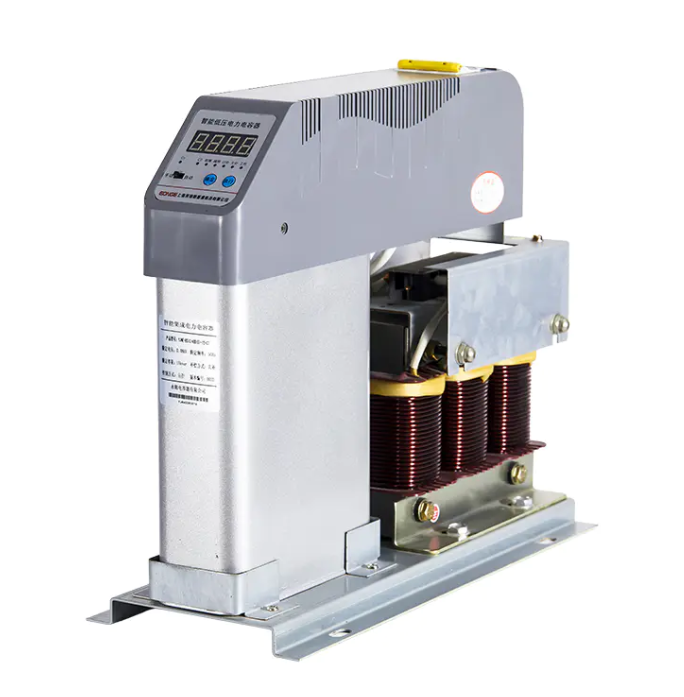
In modern power networks, voltage stability and efficient energy transfer depend on equipment that can manage reactive power without interrupting normal operation. A High Voltage Capacitor Unit is designed to provide capacitive reactive power support in transmission and distribution systems, helping utilities and industrial operators improve power factor and maintain an appropriate voltage profile. Its role is determined not only by capacitance, but also by insulation design, dielectric quality, internal connections, and the protection strategy used in the complete installation.
The capacitor element is the core of the unit. It commonly uses layers of thin dielectric film combined with conductive electrodes, wound or arranged to achieve the required electrical characteristics. Polypropylene film is widely used because of its dielectric strength, low losses, and stable behavior under suitable operating conditions. The quality of the film, electrode surface, winding tension, and edge treatment all influence electrical stress distribution. Consistent manufacturing is important because small defects or uneven electric fields can become sources of partial discharge, localized heating, or premature insulation deterioration.
After the active element is produced, it is assembled into a sealed enclosure with terminals, insulating supports, and, where applicable, internal fuses or other protective components. The enclosure must provide mechanical strength and resist environmental exposure at the installation site. Weld quality, sealing materials, terminal design, and surface treatment contribute to long-term reliability. Depending on the product construction, the dielectric system may use an impregnating medium or a dry-film arrangement.
During operation, the unit draws leading current when connected to an alternating-current network. This current supplies capacitive reactive power that offsets part of the inductive reactive demand from motors, transformers, and other equipment. By reducing the amount of reactive power that must travel through upstream lines, a properly engineered capacitor installation can reduce current loading and associated losses. It can also support bus voltage, particularly where loads vary over the day.
High-voltage applications require careful control of electric-field concentration. Insulating distances, bushing geometry, conductor clearances, and enclosure grounding must be coordinated with the system voltage and the installation environment. The design must also account for transient overvoltages, switching events, and possible resonance with network inductance. Harmonic studies are especially important where converters, variable-speed drives, or other nonlinear loads are present. In such networks, a capacitor bank may require series reactors or a tuned filter arrangement to avoid undesirable harmonic amplification.
Protection and monitoring are essential parts of a dependable installation. Depending on the design, individual elements may include internal fuses, while external protection may use unbalance detection, overcurrent protection, overvoltage protection, and suitable switching devices. A discharge path is required so that residual voltage falls to a safe level after disconnection, in accordance with applicable standards and site procedures. Operators should never assume that a disconnected capacitor is immediately safe to handle; the prescribed waiting, grounding, and verification steps remain necessary.
Selection begins with a study of the electrical system rather than a simple comparison of catalogue ratings. Engineers should review nominal system voltage, required reactive power, frequency, expected load profile, harmonic content, ambient temperature, altitude, pollution level, and available installation space. They should also determine whether the application needs a fixed bank or an automatically switched arrangement. Switching frequency, inrush current, back-to-back switching conditions, and coordination with upstream protection can affect the choice of contactors, breakers, reactors, and control equipment.
Installation quality has a direct influence on service life. The unit should be mounted according to the manufacturer's orientation and clearance instructions, with adequate ventilation and access for inspection. Connections must be tightened to the specified torque, and grounding conductors must be correctly sized and securely attached. Outdoor installations may require additional attention to moisture, salt, dust, and solar exposure. Before energization, commissioning personnel should verify wiring, insulation condition, capacitance balance where applicable, protective settings, and the operation of switching and discharge devices.
Routine maintenance should follow the equipment documentation and the site's electrical safety program. Visual inspections can identify corrosion, damaged terminals, oil or compound leakage where relevant, contamination, bulging, or signs of overheating. Any abnormal noise, repeated protective operation, or visible deformation should be investigated by qualified personnel before the equipment is returned to service.
For utilities, substations, renewable-energy facilities, and large industrial plants, a reliable capacitor solution supports power quality planning and efficient network operation. Procurement teams should assess manufacturing controls, test documentation, applicable standards, traceability, and technical support alongside the electrical rating. A carefully specified High Voltage Capacitor Unit can form a dependable part of a broader reactive-power strategy when it is matched to network conditions and maintained under an appropriate operating plan. Product options and related electrical equipment from Shanghai Yongjin Electric Technology Co.,Ltd. can be reviewed through https://www.eonge.net/product.